
The story · five acts
From the chef
to the glacier.
What you hold in your hand is not the fruit of a brand strategy. It is the result of an encounter, of a shift, of a long detour. Here is how.Act I
The lack
The observation
For a long time, we thought the gin market lacked everything except gin. Shelves full. Spectacular bottles. The same claims repeated word for word: distilled, premium, handcrafted.
And yet, tasting these gins, the same impression returned: too little soul. Twenty or so botanicals, a burnt-still finish, and the pride of being expensive. Form before flavour.
If you are just looking for another gin, the rest of the market is there. We were looking for something else.
Act II
The encounter
A kitchen. A terroir.
Pablo García — a chef trained in Michelin-starred kitchens with fifteen years in Michelin kitchens — had just opened his innovation atelier in Switzerland. It was in Valais that he found his material: a terroir of terraced vineyards and rare grape varieties, a few kilometres from the glaciers.
It all began with a question. Not a business plan, not a creative brief. One simple question:
“What if a gin could tell the story of this landscape?”
Act III
The Valais
A vertical terroir
Valais is not a backdrop. It is a vertical territory: vineyards on terraces, steep slopes, pure mountain light, grapes that few people still work as single-varietals — Chasselas, Pinot Noir, Cabernet Franc, Cabernet Sauvignon, Merlot.
Above the vineyards, the high plateaus. Above the plateaus, the Titlis glacier — its water filters slowly through alpine rock. It is this water that serves as the base for each of our distillations.
The terroir imposed its own logic: if we wanted to tell this landscape, we had to use its own materials. No Romanian juniper, no city water. Valais grape. Glacier water. Alpine herbs.
Act IV
The craft
Tools at the service of flavour
Technique is not a posture. It is a necessity. Hot distillation destroys the most delicate aromas — precisely those that make a gin recognisable. So we distil cold, under vacuum, on a rotovap. The aromas evaporate at low temperature. The nuances remain intact.
For fruits and grapes we use ultrasonic maceration: micro-cavitations that extract the matter with finesse, without burning it. More aromatic intensity, no heaviness.
Luxury is not a demonstration. These are tools at the service of flavour. Not a marketing argument — a condition for making what we wanted to make.
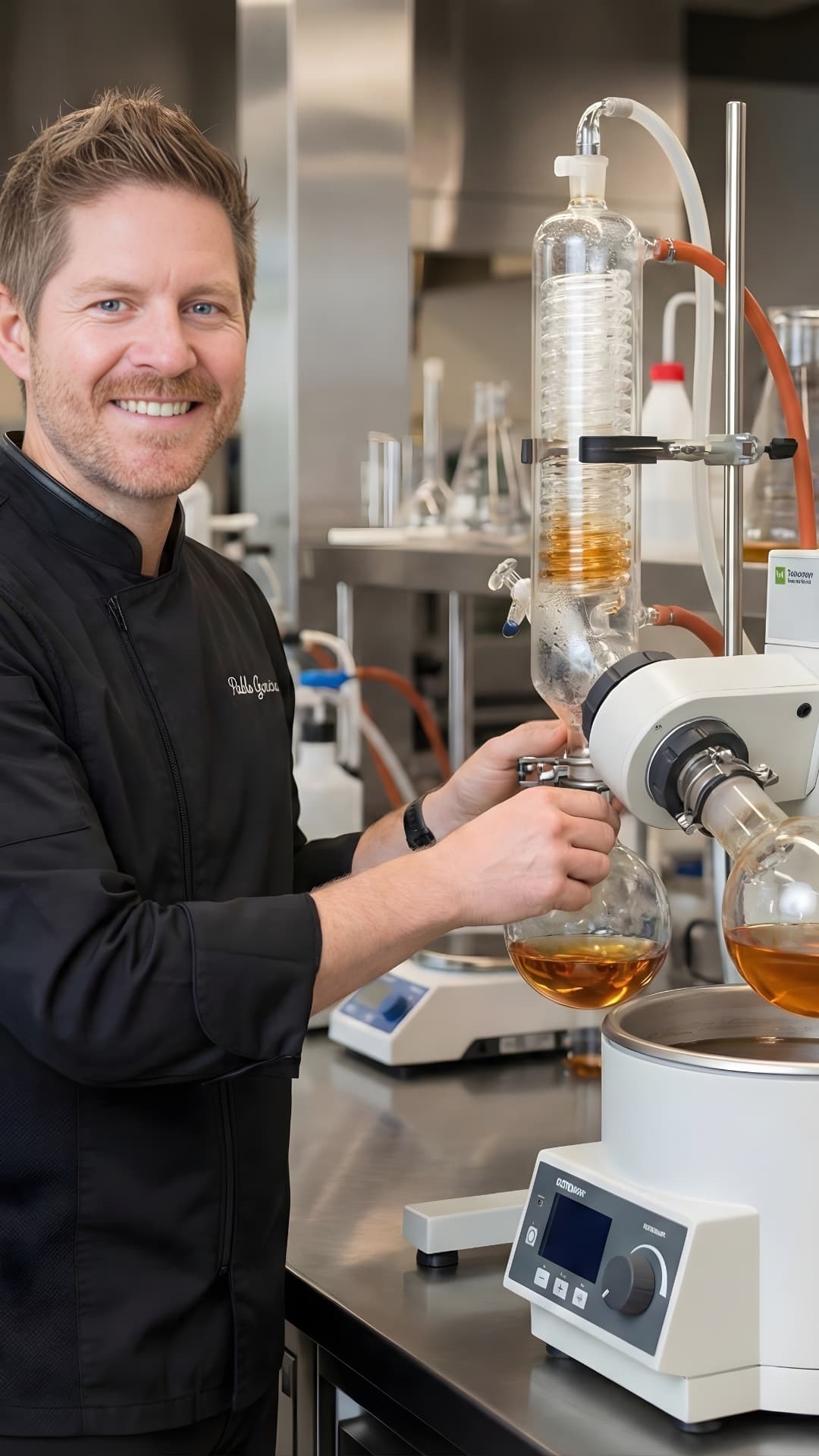
Tools at the service of flavour
Act V
The promise
For you, by you
Six expressions are open to tasting: the Sommet range, the two Terroirs, the three Grand Crus. Each tells a precise fragment of Valais.
But we wanted to go further. Not just to make people drink — to allow them to become creators of their own gin. Five sensory questions, interpreted with care, and we distil your bottle to order.
That is our promise, and it fits in one sentence:
« Tell us what you like to drink. We will make your personal Swiss gin from it. »